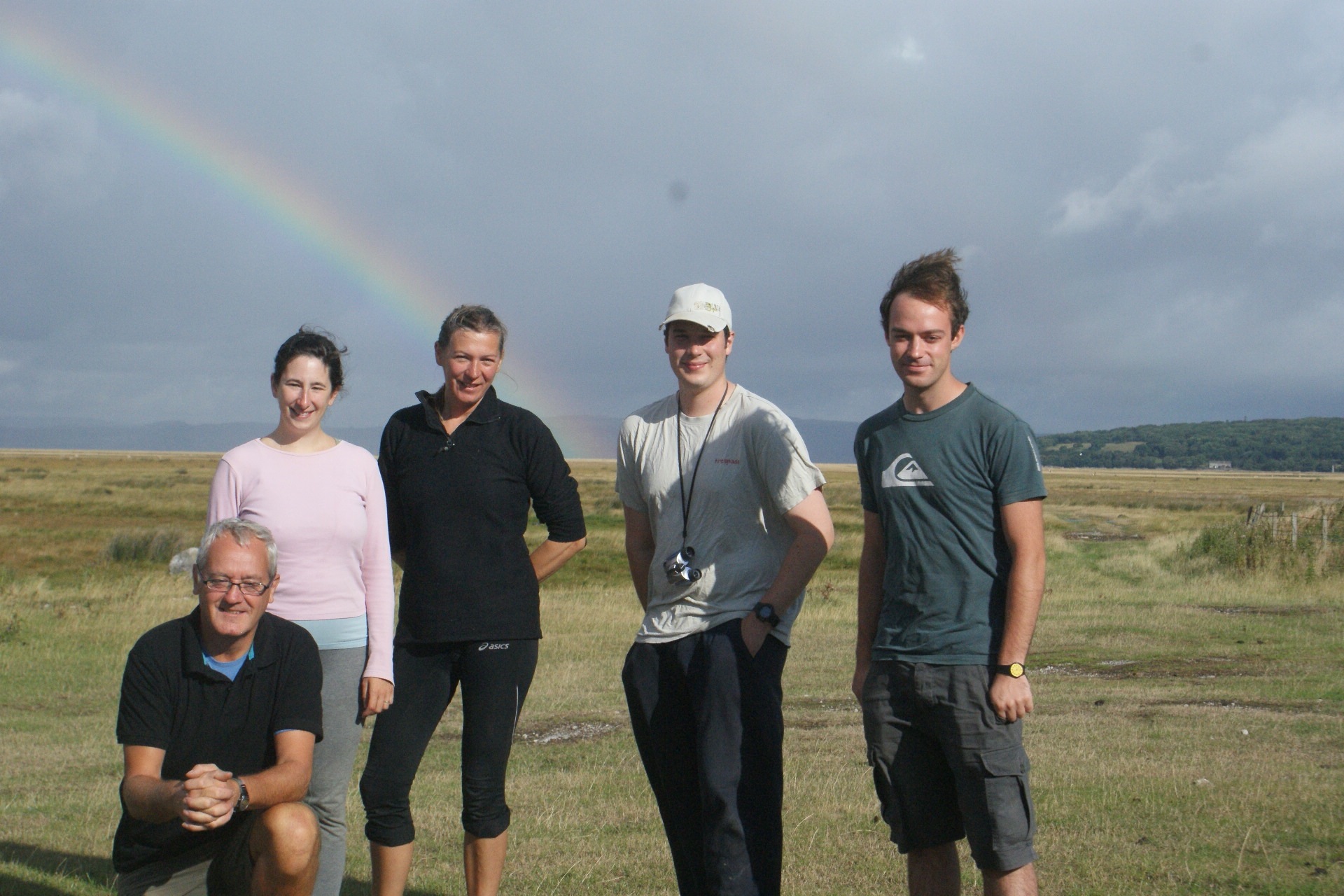
Following up from the winter campaign of the CBESS project, the SERG lab has spent an entire week6 taking samples to study the sediment stability, gas fluxes and biofilm properties from several saltmarsh and mudflat sites of Morecambe Bay. This part of the summer campaign was successful with only 2 of the 132 quadrats that could not be accessed. The team is now prepraring for the summer campaign that will take place in Essex this coming September.
Members of the SERG lab before a day of Sampling at Warton Sands
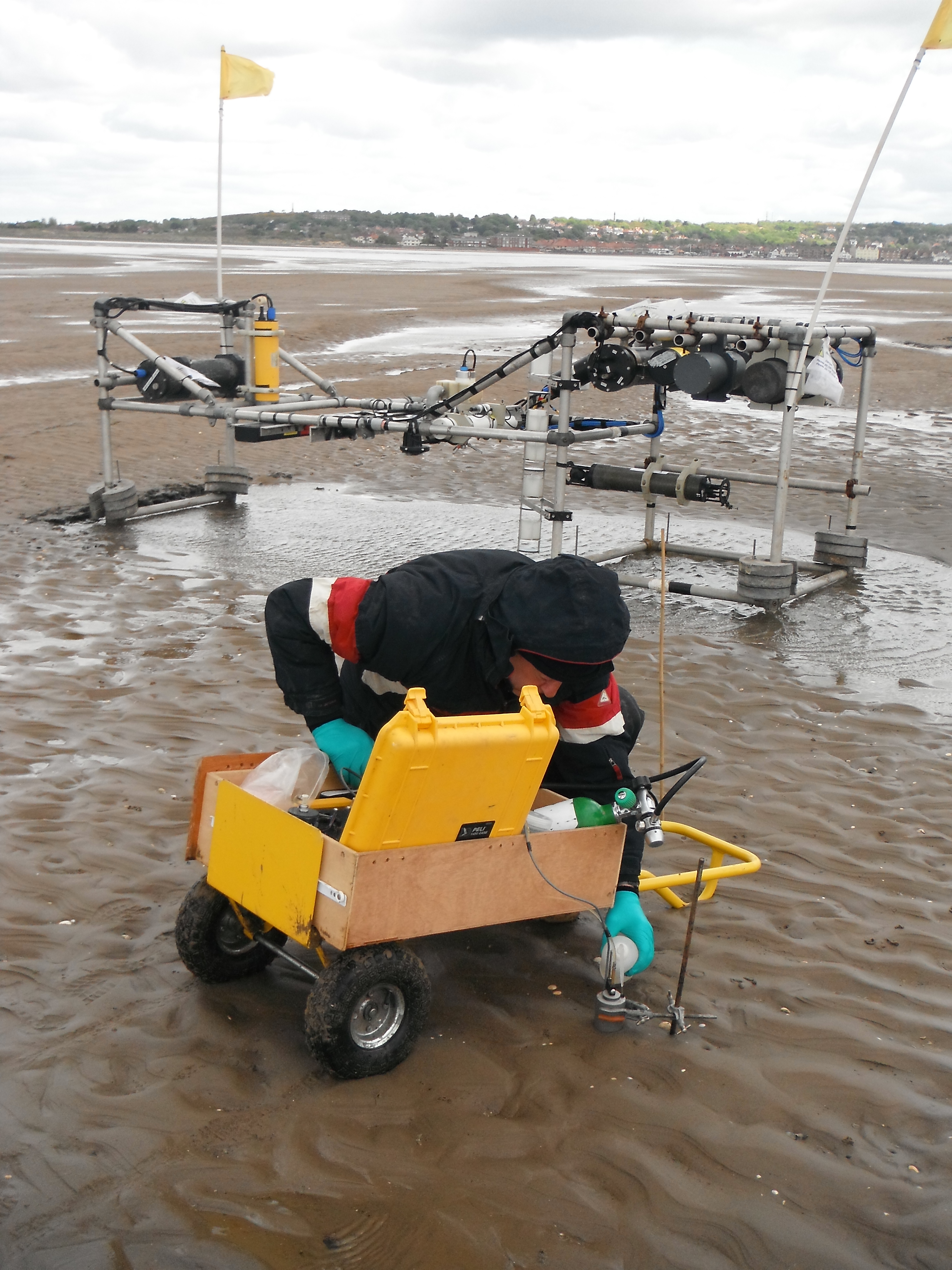
Julie, Beccy, Irvine and Jack are just back from two weeks away for an interdisciplinary field campaign carried out in the Dee estuary and involving several institutes, including SERG, as part of the NERC-funded COHBED project. Physical measurements of sediment behaviour (sandy and cohesive mixed sediments) were observed during consecutive tidal cycles using ripple profilers, as well as state of the art optical and acoustic instruments deployed by COHBED partner institutes (NOC Liverpool, Plymouth, Bangor and Hull universities), while the biological characteristics of the sediment at each site were assessed by the SERG members. These measurements were related to the current velocities at 3 sites on the intertidal flats, with biological and physical sediment properties assessed during low tide and also during tidal immersion.
The influence of the microphytobenthic community and the adhesive polymers produced by these organisms, on sediment erosion and bedform formation was determined. Temporal variation in biological properties within the sediment bed were assessed through repeat sampling both over and within tidal immersion periods, and the dissolution of the polymers into the water column was determined with a time series of water samples taken close to the bed during tidal immersion.
Irvine deploying the CSM
The measurements observed across all institutes will provide a comprehesive dataset allowing the inclusion of both physical and biological properties on sediment behaviour, in particular sediment erosion, transport and ripple formation in future predictive models.
Pfor. Alan Decho sampling for biofilm in the Eden Estuary
Prof. Alan Decho visited the SERG lab for 3 months to do some collaborative work on the communication of bacteria living on sediment biofilm and using quorum sensing. You can clear here to learn more about his work.
Welcome to Jack Maunder, who has joined the SERG lab for the next two years to work as a technician on the CBESS project. Jack will contribute to the fieldwork campaigns in Essex and Morecambe bay as well as the satellite work taking place in the Eden. He will also be in charge of processing the samples back in the lab.
Jack has a MSci in Marine Biology from the University of Southampton. He gained experience in sediment ecology while working on his masters project, entitled ‘Assessing the distribution and reproductive capacity of wild Crassostrea gigas in Poole Harbour’. His key interests are in the ecology and management of intertidal areas, fisheries and aquaculture science and the effects of alien species introductions.
Starting on Monday the 29th of October, Meriem Kayoueche-Reeve joins our team as the Project Officer for the CBESS project for the next 3.5 years. She will be based in the SOI, in the SERG lab. Her role is the day to day co-ordination of the CBESS project. She will also assist Tim Stojanovic (from Geography) with the organisation of public surveys and questionnaires in support of the socio-economic components of the project. In addition to this she will conduct public and commercial outreach activities related to the project.
Meriem has a BSc in Environmental Biology (2006) and a MSc in Biological Diversity (2008) from Plymouth University. Her experience to date has been in environmental public engagement and outreach; organisations that she has worked for include: BTCV (working with hard to reach 16-18 years olds in practical conservation) and RSPB (re-introduction of white-tailed sea eagles to east Scotland). She also spent 18 months in Oman, working freelance for an environmental consultancy, Outward Bound Oman, and as a supply teacher in an Omani primary school.
Applications are being invited for a research technician to join the Sediment Ecology research Group, at the Scottish Oceans Institute and School of Biology at University of St Andrew to carry out direct measurements of sediment ecosystem functioning and sampling of sediment cores for later laboratory processing (Reference ML1036). For more details see the position description (link above) and/or contact Dr Claire Golléty ([email protected]).
Like every year, a group of staff members and postgraduates from our lab contributes to the Junior Honours field course of the School of Biology at the University of St Andrews taking place in Orielton, Pembrokshire Coast in Wales.
This course offers students the opportunity to discover the ecology and biodiversity of coastal habitats, in particular rocky shores and develop their research skills by building and carrying out a small research project.
Applications are invited for a Research Assistant to join the School of Biology at the Scottish Oceans Institute, at the University of St Andrews to act as the CBESS project officer and contribute to some of the socio-economic work of the project (reference number: ME1573). For more details see the position description (link above) and/or contact Dr Claire Golléty ([email protected]).